
Camp Fire Alumni Lorrie Scott: A Lifetime of Belonging
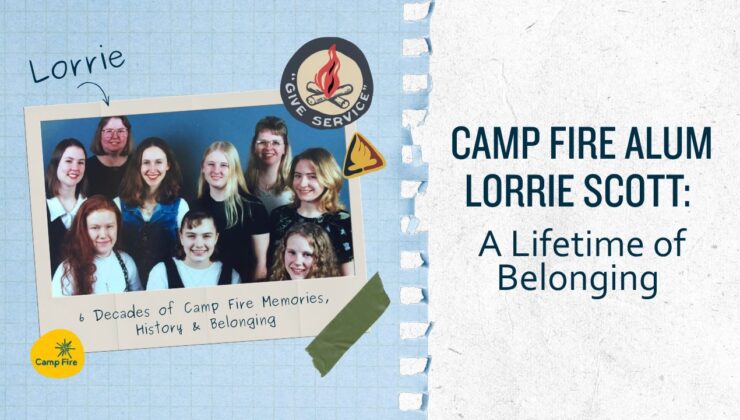
When Lorrie Scott talks about Camp Fire, she doesn’t start with awards, leadership roles, or the decades she has spent preserving the organization’s history.
It was the place where she found belonging.
In 1960, Camp Fire’s 50th anniversary year, Lorrie was a second grader struggling through what she describes as “two and a half years of misery.” After an illness kept her out of school, she was transferred away from her neighborhood school and bused across town. She felt isolated and disconnected from her classmates.
That all changed one day when a woman visited her classroom to talk about Camp Fire. Up until that point, Lorrie remembers her teacher as being especially hard on her. But on the day Camp Fire was introduced, something shifted.
 “She was really, really nice that day,” Lorrie says.
It was a small moment, but it stood out. And it opened the door to a new experience in Lorrie’s life that would change everything.
At the time, group sizes were limited, so it took awhile before Lorrie was able to find a spot.
“Eventually I got in a group,” she remembers. “Then I got to go back to my neighborhood school, and I finally started having friends again.”
Being part of the group felt different right away. Lorrie thrived in this environment, where she and her fellow Camp Fire girls enjoyed working on projects together, earning beads (no beads until out of Blue Birds in 4th grade.), and sharing experiences.
When the group’s leader announced she was moving away, Lorrie was devastated. For a time, it seemed like no one would be able to fill the role. But then, Lorrie’s mother stepped in.
“My mother came home one day and told me she would be the leader,” Lorrie says. “My reaction? ‘You’ve got to be kidding!’ She wasn't somebody who had ever had opportunities in her life to volunteer.”
What followed was an 11-year commitment.( my mom ( 10 years for my mom) Lorrie's mother led the group all the way through high school, helping create a community that still remains connected more than six decades later.
The friendships within her group kept her connected to Camp Fire throughout her childhood.
But it was camp that transformed the organization from an after-school activity into something much bigger.
"It was an escape," she says. "It was a healthy, safe, inclusive place."
Growing up, home wasn't always easy, so the time away at camp was especially treasured.
Determined not to miss camp, Lorrie babysat, picked berries, and took whatever work she could find to pay her way each summer.
Once she landed a spot at camp, she never wanted to leave.
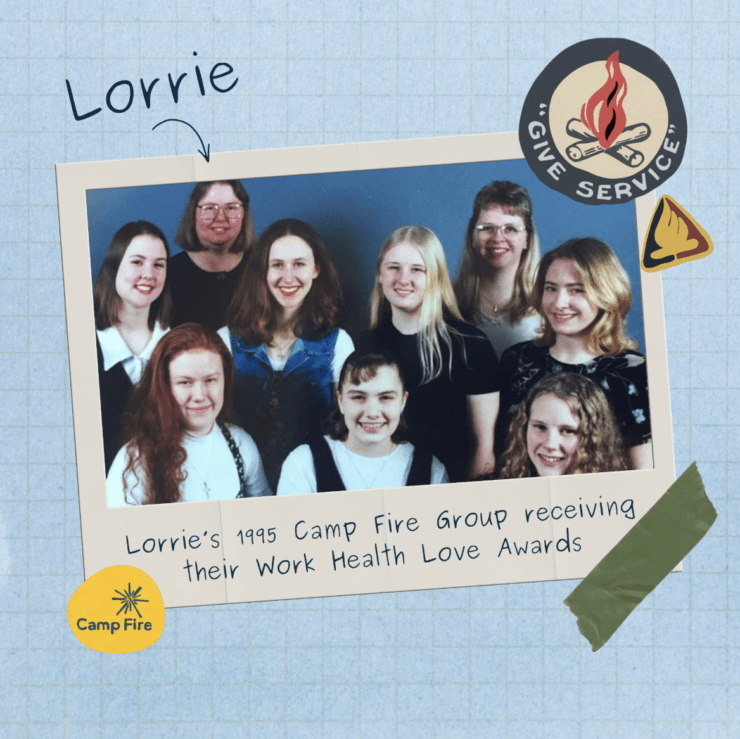 "The maximum you could go was two weeks ( in RCA, the counselor in training program at Camp Sealth known as Resident Camp Aid)," she says. "I could have been there every single day ( of the summer.")
Camp introduced her to new experiences, new possibilities, and role models who changed the way she thought about her future. At the time, Camp Fire counselors had to be enrolled in college ( or had graduated).
Even though no one in her family had ever attended college, Lorrie was motivated by the requirement, determined to qualify to work as a counselor.
"There was no way that I wasn't going to go to college," she says with a laugh. "Because I had to go to camp."
She eventually studied recreation and environmental education, worked professionally for Camp Fire councils in California and Washington, served as a (day)camp director and Self-Reliance instructor, and spent decades helping young people discover the same sense of belonging she found as a child.
None of it would have happened without Camp Fire.
Along the way, she collected stories.
One of her favorite memories happened during a summer at Camp Wyandot in Ohio. Coming from the Pacific Northwest, Lorrie had never seen lightning bugs.
Standing outside a cabin her first evening at camp, she became startled by flashes of light all around her.
"I said, 'I don't want to be an alarmist, but I think we're on fire.'"
The staff member she was speaking to burst out laughing.
"They were lightning bugs and I had never seen one before."
Today, Lorrie's connection to Camp Fire extends far beyond her own experiences. For years, she has served as one of the primary caretakers of the Central Puget Sound Camp Fire archives, helping preserve photographs, artifacts, newspaper clippings, uniforms ( Camp Fire never called our clothing as uniforms, but costumes), and stories from generations of Camp Fire youth and volunteers.
Her passion for history began when she stumbled across a small Camp Fire museum hidden in the basement of the Seattle council office.
"I walked by a sign that said museum and I thought, 'We have a museum?'"
She started to explore, and right away, she knew she had to join the museum committee.
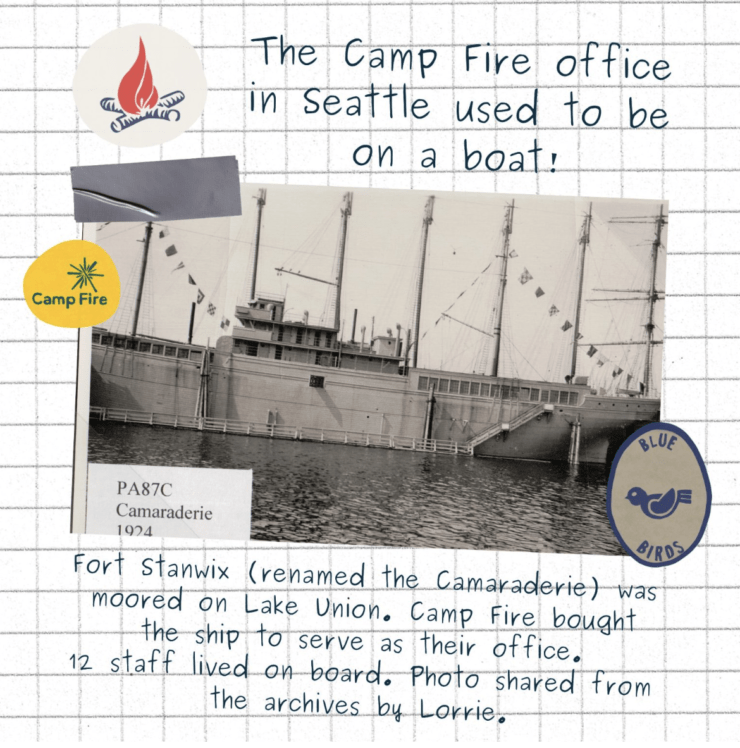 Lorrie was the youngest committee member by far, joining when she was in her mid-thirties.
“All the other women were in their seventies to nineties. So my job was to lift boxes and carry heavy things for them.”
While she would have preferred to get right to the job of reading the history books rather than lifting them, the role allowed Lorrie the chance to listen and absorb stories and wisdom from the older women on the committee.
As she filed away old photographs, documents, letters, and news articles, Lorrie kept finding herself in awe of Camp Fire’s history.
Among the artifacts Lorrie has helped preserve are a photograph of Camp Fire Girls meeting Amelia Earhart shortly before her final flight and an autographed photo of Helen Keller. She has also uncovered records documenting Camp Fire’s early work supporting people with visual impairments through Braille translation and other accessibility efforts.
Time and again, she came across records documenting Camp Fire’s longstanding commitment to service, community engagement, and inclusion. Though, as Lorrie put it, “we didn’t call it that back then.”
For Lorrie, preserving these stories isn’t about nostalgia. It’s about making sure future generations understand the impact Camp Fire has had on communities for more than a century.
But even after decades of volunteering, leadership, and historical preservation, the thing Lorrie values most hasn't changed.
It’s the same thing she found as a second grader: a deep sense of belonging and safety.
Ask Lorrie about her favorite Camp Fire memories, and she returns immediately to camp.
She remembers the glowing lakeside ceremonies, the smell of woodsmoke, the music, and the sense that everyone was connected to something larger than themselves.
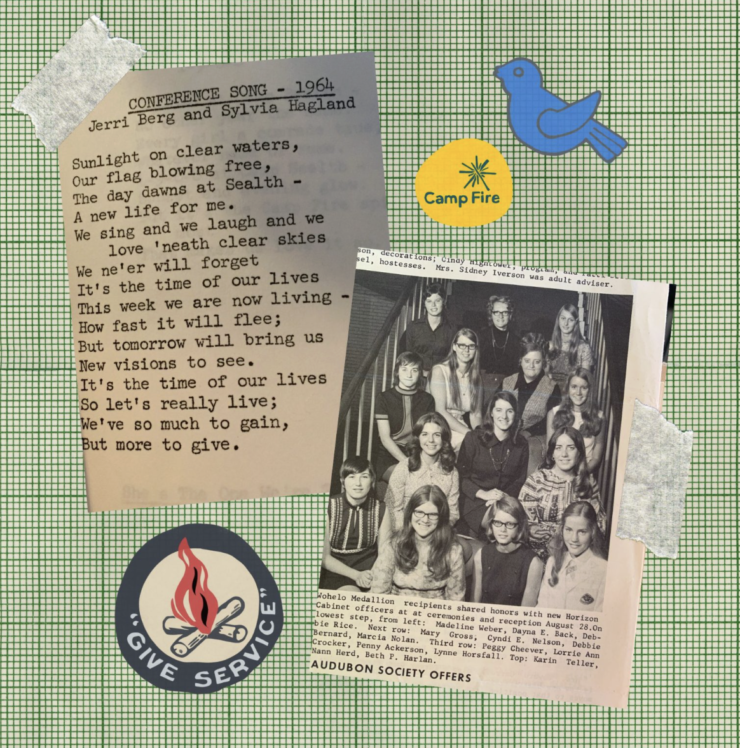 Several times a year, she still gathers with fellow Camp Fire alumni, pulls out a guitar, and sings many of the same songs they learned decades ago.(I do not play a guitar, sadly, but my talented friends do)
"When we get together with our music," she laughs, "I feel like we're a '60s folk band."
For Lorrie, Camp Fire's greatest gift wasn't a badge, an award, or even a career path.
It was community.
"The people that I met in second and third grade are still my friends," she says. “Those that are living now, we still connect on Facebook and get together in person sometimes.”
More than 60 years after joining Camp Fire, that community is still going strong.
And that, she believes, is what Camp Fire has always been about.
It’s not just the activities or the traditions, but the way it brings people together, gives them a place to belong, and helps them carry that sense of connection into the rest of their lives.